Bedtime Stories: Free Texts, Audio and a Routine That Works
19/08/2026
Where to find free bedtime stories to read or listen to, and how to turn story time into a routine that actually ends with a sleeping child.
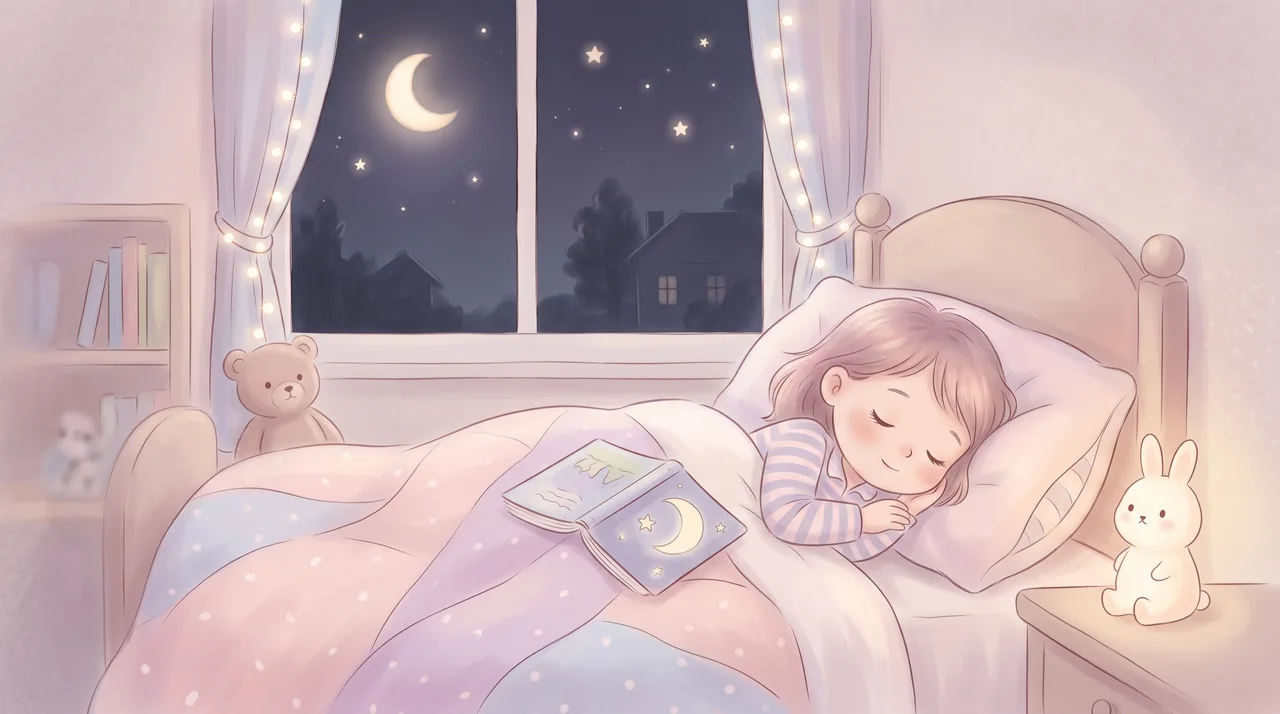
You can find free bedtime stories in three places: classic tales to read aloud on Project Gutenberg and in the Internet Archive children's library, free read-aloud stories on Storynory, and children's audio on BBC Sounds (CBeebies Radio). But when it comes to falling asleep, the routine matters more than the specific story: the same time, dim lights, a calm voice and the same closing line every night.
How to choose a bedtime story by age
The most common reason a bedtime story "doesn't work" is simple: it doesn't fit the child's age. A toddler can't follow a plot, and a preschooler gets bored with a board book. How reading stamina changes with age in general is covered in our guide to choosing children's books. A rough breakdown:
- Ages 1–2: nursery rhymes and board booksThe rhythm and melody of your voice matter more than the story. Short nursery rhymes (Pat-a-Cake, Twinkle, Twinkle, Little Star) and board books with one picture per page. Read them over and over — at this age, repetition has a purpose, it isn't boring.
- Ages 2–4: simple stories with repetitionCumulative tales where a new character keeps joining in, like The Enormous Turnip or The Gingerbread Man. Soon your child will be "reading" along with you — saying the repeated lines together is the first step toward loving books.
- Ages 4–6: classic fairy talesGrimm, Andersen, Aesop's fables, Beatrix Potter and A. A. Milne. Your child can now follow a longer storyline and a simple moral. At bedtime, though, pick the gentler ones — Winnie-the-Pooh, yes; witches and big bad wolves right before sleep, maybe not.
- Age 6 and up: chapter booksOne chapter every night. Looking forward to what happens next is one of the strongest motivations to read there is — and it works even for kids who can already read but don't feel like doing it on their own.
Free read-aloud and audio bedtime stories online
A read-aloud or audio story comes in handy when you're running late, traveling, or when your child takes a long time to fall asleep and your voice is giving out. How to choose an audiobook by age and type of audio is covered in our guide to audiobooks for kids. Free sources worth knowing:
- StorynoryFree read-aloud tales at storynory.com — fairy tales, myths and original stories, narrated and ready to play whenever you need one, not just at a set time.
- BBC Sounds (CBeebies Radio)The BBC's children's audio: stories, songs and gentle shows for little ones. The calmer programs work well as background sound while your child drifts off.
- Bedtime videosThere are plenty of animated and read-aloud stories online, with one catch: it's a screen. As a bedtime story, video works better in the afternoon — screen light right before sleep pushes falling asleep back. When video is enough and when it isn't is covered in read-aloud stories on YouTube.
- Bedtime story podcastsSearch "bedtime stories" in any podcast app and you'll find free read-aloud tales — quality varies, so listen to an episode yourself first. For audio at night, the rule is: sound only, no screen.
Bedtime stories to read: where to get free texts
Classic fairy tales are in the public domain — the copyright on the Brothers Grimm, Hans Christian Andersen and Aesop expired long ago. On Project Gutenberg and in the Internet Archive children's library you'll find full texts of Cinderella, Snow White or The Ugly Duckling, free and legal, to read on screen or print out. More legal sources of free texts are in our article on children's stories to read online.
Just watch the language: older translations have long sentences and words today's kids don't know. With preschoolers, it's common and perfectly fine to simplify the text as you read — fairy tales were passed down for centuries by retelling, not word-for-word quotation.
The other route is your public library. A children's library card is usually free, and you can borrow dozens of storybooks you'd otherwise be buying. For bedtime reading, the library is the cheapest source there is.
Reading a book, audio, or making it up?
No option is "the right one" — each fits a different moment, so feel free to switch depending on how the evening is going.
| Option | When it works | Downside |
|---|---|---|
| Reading a book | The core of the bedtime routine — time together, closeness, your child sees the words and pictures | Takes your energy; after a long day, parents nod off while reading too |
| Audio story | Car trips, sick days, or when your child stays awake long after the story | No closeness or pausing for questions; the pace doesn't adjust to your child |
| Making it up | Lights are out and your child still isn't asleep; the story can be tailor-made | Inventing a story after a long day is hard work — an outline helps (below) |
| Personalized book | As a gift and a treat within the routine — your child is the hero of their own story | Won't replace the everyday classics; it's one book, not a library |
A short bedtime story to tell from memory
The most useful story is the one you can tell without a book — after lights-out, at Grandma's, in the car. This one has a proven sleepy structure: the hero says goodnight to everything around him, and with each goodnight your voice gets slower and quieter.
A bedtime routine in five steps
A story puts kids to sleep best as part of a predictable routine. Campaigns like Read Across America and the Summer Reading Challenge exist to keep families reading together — and bedtime is when a daily reading habit is easiest to keep.
- 1Same time, same orderBath, pajamas, teeth, story, lights out. Predictability tells a child's brain "now it's time to sleep" — more powerfully than any amount of coaxing.
- 2No screens for an hour before bedNo TV or tablet, even if there's a story playing on it. Screen light suppresses melatonin and pushes sleep back.
- 3Let your child choose — but from just two or three booksHaving a say cuts down on negotiating. Choosing from the whole bookshelf, though, is stimulating; two or three books on the nightstand are enough.
- 4Read slower and softer than feels naturalToward the end of the story, lower your pace and volume even more. A yawn in the middle of a sentence isn't a mistake — it's a technique.
- 5End every night with the same lineA sleepy closing line — something like "And now the whole forest is asleep. Goodnight." — works like a bookend to the day. After a few weeks, your child will be saying it with you.
Mistakes that wake a child up instead
When bedtime reading ends with a wound-up child, it's usually down to one of these:
- Action-packed or scary storiesChases, battles and monsters belong in the afternoon. At night, choose stories where everyone ends up going to sleep — when the plot builds up, so do the kids.
- A long new story right before lights-outA new story means questions, suspense and "what happens next?" Read new books early in the evening and finish with a familiar favorite or a short sleepy story.
- "Just one more" with no ruleNegotiating wakes kids up more reliably than caffeine. Agree on the number ahead of time ("two tonight, you pick which") and stick to it — a rule that sometimes bends isn't a rule.
- Reading as a reward or punishment"If you behave, I'll read to you" turns the story into a bargaining chip. Bedtime reading should be a certainty that holds every single day — and it's that certainty kids fall asleep to.
When your child is the hero of the story
Kids love stories about themselves — that's why made-up stories featuring their own name, room and teddy work so well. The paper version of that joy is a personalized book: with Hero of the Book, a single uploaded photo becomes a story where the hero looks like your child and their name appears throughout. Before you pay, you'll see a suggested title, a story preview and the dedication — but not the finished illustrations; the book is a one-time purchase, no subscription.
For the bedtime routine, it's a special treat and a great gift, not a replacement for the everyday rotation of stories: it's one book, not a library.