
A present for your teenage daughter (11–15): let her choose
1/10/2026
A teenage daughter (11–15) will appreciate a present she chooses herself. How to leave the choice to her without it turning into a reproach, and what to write in the card.
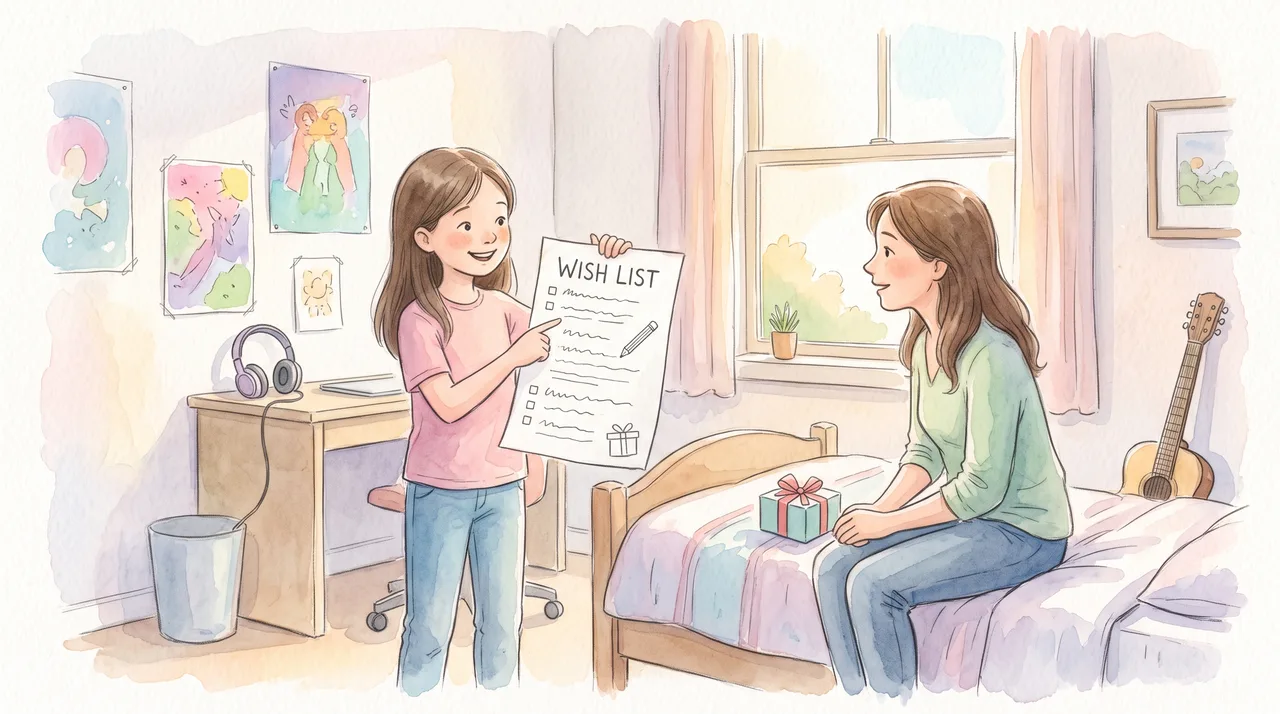
A teenage daughter between 11 and 15 is usually happiest with a present she chose herself: something from her own wish list, money with a clear purpose, or a shopping trip together where she does the choosing. A surprise only works when it matches her taste, not your idea of who she ought to be. A present turns into a reproach the moment it carries the message “you should change” or “now you owe us”.
Why a present she picks herself wins at 13
Between eleven and fifteen, a girl is putting together her own identity: clothes, music, her room, her friends. Something she chose says “this is me”. Something a parent chose often says “this is what I think of you” — and at this age that is a sensitive spot.
Psychologists call it the need for autonomy: we experience things as our own when we get to make decisions about them. In teenagers that need is at its strongest, because they are only just starting to separate from their parents.
There is also a more general finding about gifts. In a study by Francesca Gino and Francis Flynn, recipients appreciated what they had asked for more than an unrequested “original” surprise. The givers, meanwhile, believed the opposite — that a requested gift feels impersonal. With a teenage daughter this mistake costs even more: a miss isn’t brushed off with a polite “thanks”, it becomes something that sits in a drawer and reminds her that nobody listened.
Letting her choose doesn’t mean giving up on a personal present. What makes it personal is that you listened and trusted her, not that you caught her by surprise.
When a present becomes a reproach
These presents are usually well meant, but your daughter hears something else in them. You can spot them because they make more sense to you than to her.
- A present with a lesson attachedDumbbells, acne cream, a book on how to behave, or a planner “so you’ll be more organised”. She doesn’t read care into it, she reads judgement: this is what’s wrong with you.
- A present with a footnote“So look after it, it cost a lot.” An expensive item with a reminder of its price is a debt, not a gift. The phone then becomes leverage in every argument.
- A present that depends on performance“You’ll get it if you bring home top marks.” That’s a reward, not a birthday present. If you want to reward her, do it separately and don’t mix it with the celebration.
- A present that is really about youYour favourite book from childhood, the band of your youth, a hobby you’d like to steer her into. You can share these, but as an extra offer, not as the main present.
- A present that keeps tabs on herA smartwatch with location tracking, or a diary you’ll later peek into. Safety measures are agreed openly, not wrapped in paper with a bow.
- A present she has outgrownA soft toy, a pink “princess” set, anything she can’t show her friends. At twelve, the line of what counts as “babyish” moves faster than parents notice.
Gifts for girls aged 13–14: how to let her choose
There are several ways to let her choose. They differ in how much work falls on you, how much on her, and how much surprise is left.
| Format | When it works | What to watch out for |
|---|---|---|
| Something from her wish list | When she keeps a list (an app, a note on her phone) and it’s specific enough | Buy exactly the version she wants — no “similar but cheaper” |
| Money with a purpose | She’s saving for something bigger: a bike, a concert, a phone | Write down what it’s for, or it will vanish in small purchases |
| Shopping together | Clothes, make-up, things for her room | She chooses, you pay and don’t comment — set the limit in advance |
| A voucher for a specific shop | She knows where she shops, and so do you | A generic gift card can look as if you had no idea what to get |
| An experience she plans herself | A concert, the cinema with friends, a day trip | Agree with her who’s going; a parent as chaperone isn’t a given |
| A surprise based on her hints | She mentioned something a month ago and has forgotten about it | This is the one place a surprise makes sense — it shows you were listening |
How to ask what she wants without it feeling like an interrogation
- 1Ask earlyThree or four weeks ahead, not the night before the party. She has time to think it over and you have time to track down the exact item.
- 2Name a budgetWithout a frame she either asks for the impossible or is too shy to ask for anything. A clear amount gives her freedom to choose and gives you peace of mind.
- 3Let her send you linksMuch safer than a description like “you know, that hoodie”. Size and colour stop being a guessing game.
- 4Don’t comment on her choiceIf it’s within budget and not dangerous, don’t judge. “That’s an awful colour” does more damage than a bad present.
- 5Add a small personal touchA handwritten card or a little something you pick yourself. The main present is her choice; the personal extra is yours.
What to write in a card for your teenage daughter
The card is where you can be personal. Keep it short, no lectures and no “when you’re grown up”. Lines you can borrow:
A present for a 13-year-old girl from her grandmother or aunt
The same applies to a grandmother or aunt, with one advantage: they can ask the parents what’s on the list and avoid doubling up. The presents that go worst are the ones more distant relatives choose based on how they remember the girl from three years ago.
If you really have no idea, it’s more honest to give money with a note about what it might go towards than an item picked blind. More ideas for grandparents are in the article A present for your granddaughter, and an overview for every age is in A present for your daughter by age and stage. If you’re also shopping for a boy of a similar age, have a look at a present for your son by age.
A personalised book: when it works and when it doesn’t
A book in which your daughter is the heroine feels like magic to a seven-year-old. To a thirteen-year-old, as a surprise, it often feels babyish — and that’s exactly the kind of present she has outgrown.
It’s a different story when she creates it herself. In the Hero of the Book wizard she can choose a world and a plot, or write her own story, and pick one of 20 illustration styles, such as anime or graphic novel. The finished e-book is usually ready within 15 minutes. Older girls tend to make one for a younger sibling or as a present for their grandmother rather than for themselves — and that counts too, because they’re the ones deciding. How such a book comes together is described in the article A personalised book.
Sources
- Gino, F., Flynn, F. J.: Give them what they want: The benefits of explicitness in gift exchange (Journal of Experimental Social Psychology, 2011)
- Self-determination theory — the theory of autonomy, competence and relatedness (Wikipedia)
- HealthyChildren.org (American Academy of Pediatrics): Teen — adolescence and the relationship with parents