
Walking to School: Reflectors, Route Practice, Going Solo
15/10/2026
Walking to school without the worry: where reflectors go, how to practise the route step by step, and how to tell your child is ready to go alone.
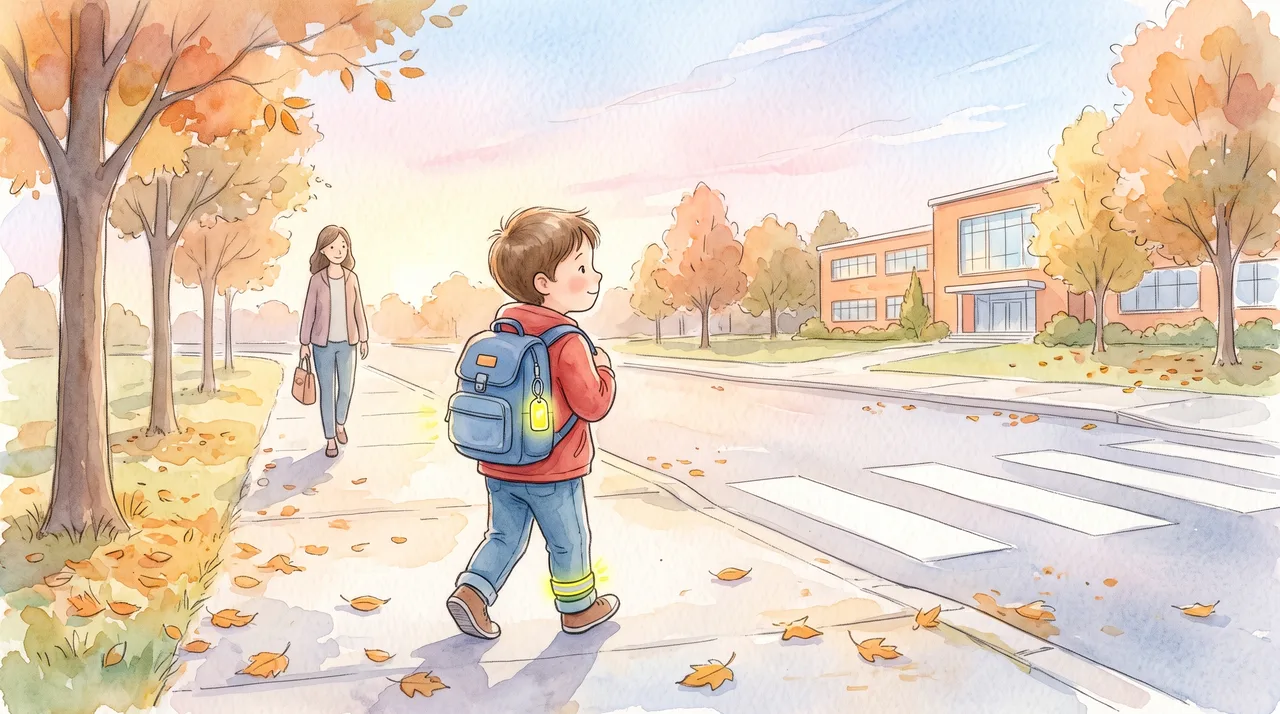
A safe walk to school rests on three things: your child can be seen (reflectors on the side nearest the road and at headlight height), knows one fixed route they've walked with you many times, and knows what to do if something goes wrong. There's no set age for walking alone. You can let them go once they've led you along the route several times in a row without a mistake — while you simply walk behind and say nothing.
When to let your child walk to school alone
Deciding when a child walks without an adult is up to the parent — and so is the responsibility. Check with your school or after-school programme what they need from you if your child is going to leave on their own; without it, staff won't usually let them go.
That's why age is a poor yardstick. It's better to ask about specific skills: Does your child stop at the kerb on their own, even mid-conversation? Do they really look both ways and then check again, or just turn their head? Do they know what to do when the signal says cross but a car keeps coming anyway? Can they say no to a friendly stranger who offers them a lift?
A realistic look at the route helps too. Five minutes along a quiet street with a footpath is something a young school child can manage much earlier than twenty minutes with a crossing over a four-lane road with no lights. Younger children are worse at judging how fast a car is approaching, and a friend on the other side of the street easily distracts them. So it pays to start with a shorter stretch and add independence bit by bit, not all at once on the first day of school.
Reflective gear for the walk to school: what and where
| Item | Where it goes | What to watch out for |
|---|---|---|
| Reflective snap band | On the wrist or ankle on the side nearest the traffic | The ankle shows up best — it moves and sits at dipped-headlight height |
| Bag tag | On the bottom of the school bag, not the top loop | Hanging high and behind the back, a driver coming towards your child won't see it |
| Reflective panels on the school bag | Check the back and the sides | Often they're only on the back and missing from the side your child crosses from |
| Hi-vis vest | Over the jacket, especially where there's no footpath or street lighting | A vest under an open jacket or in the bag does nothing |
| Jacket or shoes with reflective strips | Strips on the sleeves and heels | They fade after a few washes — shine a torch on them once a season |
| Light-coloured clothing | Overall | Helps at dusk, but doesn't replace a reflector in the dark |
Why reflectors belong on the traffic side
Reflective material doesn't glow on its own; it only bounces light back towards its source — the driver. So it only works where car headlights reach: low down and on the side of the body. A bag tag tucked behind the back or high on a shoulder looks nice, but a driver heading towards your child barely sees it. A pedestrian in dark clothing is spotted only at fairly short range; with reflectors, from many times further away.
On winter mornings children often walk in half-light or in the dark, and the difference in visibility is just as big on a town street as on a country road. The simplest rule for a child: a reflector is like a beanie — in winter you don't leave the house without it.
Try it together: one evening, shine a torch from a distance at the school bag and jacket. Whatever lights up is working. Whatever stays dark, add to or move.
How to practise the route to school step by step
- 1Pick one route, not the shortest oneThe safest way is usually the one with a signalised crossing or a crossing supervisor, even if it takes a few minutes longer. Your child should always go the same way — shortcuts only once you say so.
- 2Walk it when people really walk itA street at seven in the morning looks different from Saturday afternoon: cars reversing outside the school, the rubbish truck, vans parked by the crossing. Practise in real traffic.
- 3Name landmarks togetherThe bakery, the yellow house, the fountain. Children don't remember street names, but they do remember "left at the fountain". Use the same landmarks yourself when you ask where something happened.
- 4You lead, your child commentatesFor a few days you go first and your child says out loud what you're doing and why: "We're waiting here because that car is reversing." Talking it through sticks better than listening.
- 5Your child leads, you stay quietSwap roles. Your child decides when to cross; you walk a step behind and don't step in unless there's real danger. Talk mistakes over at home, not on the footpath.
- 6Following from a distanceWalk twenty metres behind, or on the other side of the street. Once your child has led you along the route several times in a row without a mistake, they're ready for their first solo walk.
- 7First walks alone — a shorter stretchStart with the last bit: walk them to the corner where they can already see the school. Only lengthen the solo stretch once they're handling the previous one with confidence.
Danger spots adults overlook
- Parked cars by the crossingAn adult can see over them, a child can't — and the driver can't see the child. Teach them to stop at the edge of the parked car and only look from there.
- Driveways and garage entrancesA footpath across a driveway still looks like footpath, but cars back out of it and the driver is watching the road, not the footpath.
- Around the school in the morningParents stopping "just for a second", cars turning in the street, doors swinging open onto the footpath. Ironically the riskiest spot on the whole route.
- The bus stopCrossing in front of a stopped bus or right behind it is dangerous because your child and oncoming drivers can't see each other. They should wait until the bus has gone.
- The green signalA green signal doesn't mean a car will stop. Turning drivers should give way to pedestrians, but your child needs to make sure the driver has really seen them.
Rules your child will remember
Phones, watches, bikes and buses
Being able to reach you mostly reassures you; it doesn't replace your child's independence. A phone in hand at a crossing is more of a risk — agree that it only comes out on the way in an emergency. Kids' smartwatches with calling have the advantage that children don't treat them as a screen full of games; what to look out for is covered in Kids' watches: a gift that gives responsibility.
On a bike or scooter, different rules apply than for pedestrians. Young children can't yet judge traffic well enough to ride on the road alone, so ride with them until they're ready, and a helmet goes on every single time. On a scooter, keep to where it's allowed and be considerate of people walking.
Practise the bus trip the same way as the walk: where to get on, how many stops it is, when to press the bell and what to do if they miss their stop. The answer should always be the same — get off at the next one and call.
Starting school is a big change for a child even without walking there alone. Some children get the best feel for a new situation through a story in which they themselves appear — in a personalised book, the hero looks like your child from their photo and carries their name.
Sources
- The road rules and school travel guidance that apply where you live
- Your child's school and after-school programme — their arrangements for children leaving on their own