
What to Pack for Uni Halls: A First-Year's Checklist
4/11/2026
A packing list for first-years moving into halls: what they really need, what just takes up space, and which home cooking to make ahead so it keeps.
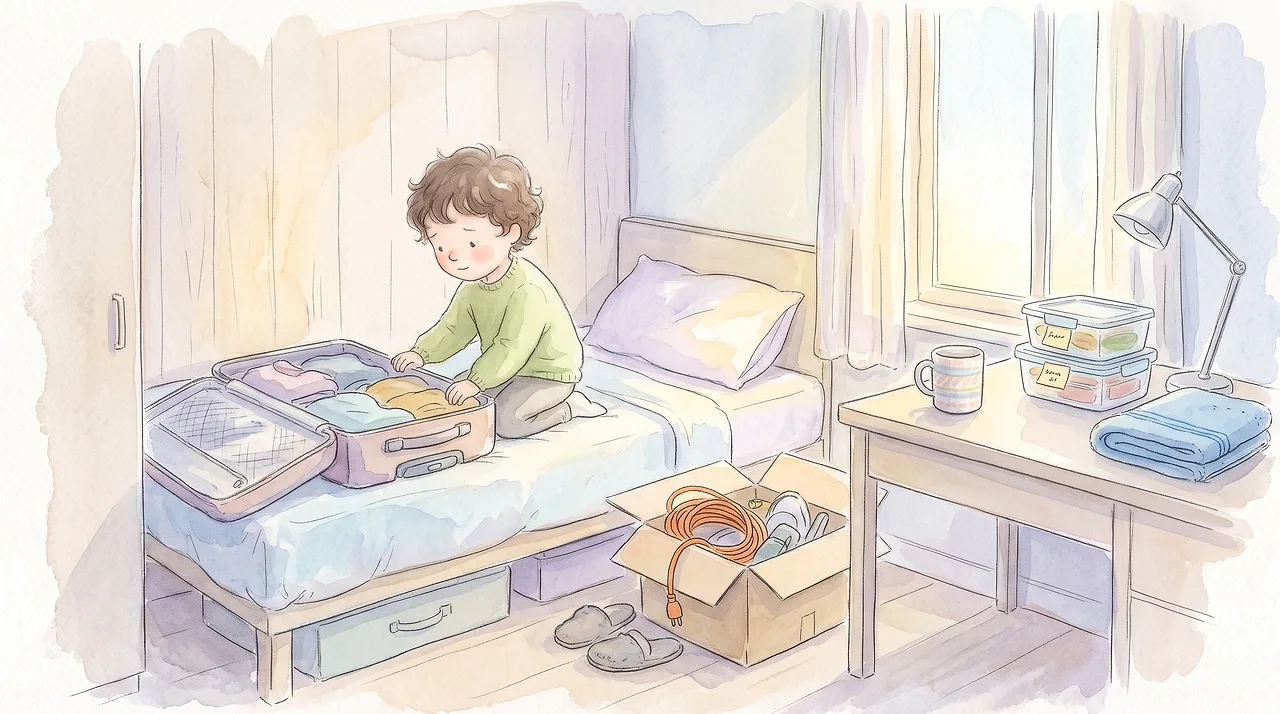
Pack mainly what the hall doesn't provide and what you can't buy nearby in five minutes: ID and paperwork, medicines, your own mug, plate and cutlery, towels, a multi-plug power board, jandals for the shower, earplugs and food for the first three or four days. Before you start packing, read the hall rules and find out what's already in the room — bedding, a bar fridge and a kettle are often provided, or banned outright. Buy the rest during the first week, once you see what you're actually missing.
Before you pack: four things to find out
- 1Read the hall rulesLook for the section on electrical appliances. Many halls of residence don't allow hot plates, cooktops or heaters in rooms, and your own bar fridge has to be registered — sometimes for an extra fee. Bringing a microwave you then have to cart back home costs you a weekend.
- 2Find out what the room comes withEmail the accommodation office or check its website: is there a fridge in the room, are a duvet, pillow and sheets included, is there a kitchenette on every floor or only downstairs? The answer will cross off half your list.
- 3Sort things out with your flatmateIf you're sharing a room, one kettle, one clothes horse and one desk lamp is plenty. A quick message before moving in saves you two of the same thing that won't fit on one shelf.
- 4Measure the spaceWardrobes in halls tend to be narrow, and only a flat storage box fits under the bed. Pack clothes for one season; a winter jacket can be couriered later or picked up after the first weekend home.
What a first-year really needs in a hall of residence
- ID and paperworkPhoto ID, any health or medical cards, the offer of place, the accommodation agreement and a passport-style photo for the student ID card. Anyone on regular medication needs enough to last until the first visit to a doctor in the new town.
- A small set of your own dishesA mug, a bowl, cutlery, a sharp knife, a small chopping board, one pot or frying pan and two containers with lids. Dishes go missing in a shared kitchen, but named ones find their way back.
- Bathroom and hygieneTwo towels, jandals for the shower, a toiletry bag or caddy (you carry it down the corridor), toilet paper for the first few days and a small first-aid kit: plasters, painkillers and a thermometer.
- Electricals people forgetA multi-plug power board — there's usually one socket by the bed, and it's already taken. Add a long charging cable and a reading lamp for when your roommate is asleep.
- SleepEarplugs and an eye mask. Halls never sleep, and O-Week is one long party in the corridor. Bring your own pillow only if you can't sleep on someone else's; bedding only if the hall doesn't provide it.
- Cleaning and laundryA dishcloth, dishwashing liquid, rubbish bags, laundry liquid and a folding clothes horse if the room has nowhere to dry washing. Washing machines in halls are usually shared and cost money per load.
What just takes up space in a hall
Parents pack these most often “just in case” — and at the end of the semester they come home unused.
- A fully kitted-out kitchenA set of pots, a blender, a toaster. A first-year cooks the same three meals on repeat, and one pot and one pan cover them. Hall rules often ban extra appliances anyway.
- Clothes for the whole yearThe wardrobe is small, and every weekend home is a chance to swap one thing for another. Pack a suit or a dress only if you know about an event that calls for one.
- A printerUniversities offer printing on your student ID card or in the library. At home a printer jams once a month; in a hall room it has nowhere to sit, either.
- A semester's worth of toiletriesSix bottles of shampoo and a tub of laundry pods take up half the wardrobe. Every university town has a chemist and a supermarket, and the prices are the same.
- Textbooks for the first weekThe reading list comes in the first lectures, and most books are in the library. Buying ahead from last year's course outline doesn't pay off.
- Decorations from a childhood bedroomOne photo or small keepsake from home does more than a box of posters. Many halls don't allow drilling or sticking anything to the walls, either.
Bring from home or buy there
| Item | Bring from home | Buy there |
|---|---|---|
| Mug, plate, cutlery | Yes — from home, named | Only if something breaks |
| Pot and frying pan | One of each from home | A second one, depending on how often you cook |
| Bedding and pillow | Only if the hall doesn't provide it | Sheets, if the mattress size doesn't match |
| Power board | Yes, you'll miss it on day one | No |
| Toiletries and laundry supplies | Enough for the first week | The rest at the nearest supermarket or chemist |
| Kettle | After checking with your roommate and the hall rules | No, if the room already has one |
| Desk lamp, clothes horse | If you have a spare at home | After the first week, depending on space |
| Pantry staples | Pasta, rice, tea and oil to start | Fresh food in town |
What to cook at home for your son or daughter to take along
The first days at uni are the busiest: enrolment, timetables, the student ID card, finding the dining hall. Food from home makes sense here — but for three or four days, not the whole semester. The fridge in the room is small and shared, and halls often have no freezer at all.
The dishes that travel best reheat in one pot or in the microwave: savoury mince, beef stew, mac and cheese, risotto, stuffed capsicums or a pumpkin soup in a sealed jar. Pack them in single-portion containers and label each with the day it was cooked. Cooked food keeps in the fridge for about three to four days, so whatever isn't eaten by Thursday goes in the bin, not into Friday.
For the trip, pack food that doesn't need chilling: a tin of ANZAC biscuits, a slice or two, banana bread, a loaf of bread and some Marmite. Sausage rolls are a classic, but they only keep a day or two chilled — make them the first night's tea. Bring soups and sauces in a chilly bin with a frozen ice pack and put them in the fridge as soon as you arrive.
More than a box of food, a few simple recipes your first-year can manage alone will help: one pasta dish, one soup, eggs three ways. Write them down on paper or send them in a text — after the first week, they'll cook from what they know, not from what's left over from home.
A note for the food box
Tuck a short note into the box or bag. A few lines from Mum or Dad read differently in a hall room than they do at home.
What to send with your first-year from the family
If you want to add something more than food for the send-off, think about what fits in a hall room and won't just get carted around for nothing. A contribution towards the first month works well while the budget settles — how to give it thoughtfully is covered in How to give money so it doesn't vanish in a weekend. If moving into a hall comes straight after finishing Year 13, you'll find ideas based on where the school leaver is headed next in Gifts for finishing school, based on what comes next.
Keep the personal touch small: one framed photo, a mug from home, a handwritten letter. In a room where everything is unfamiliar, that small thing is what turns a bed into a little place of their own.
Sources
- FoodSafety.gov — Cold Food Storage Chart — How long cooked food keeps in the fridge and freezer.