
Name and date jewellery: what to engrave and when
1/09/2026
What to engrave on name and date jewellery so it still makes sense in twenty years, which metal lasts — and why a one-year-old shouldn't wear it.
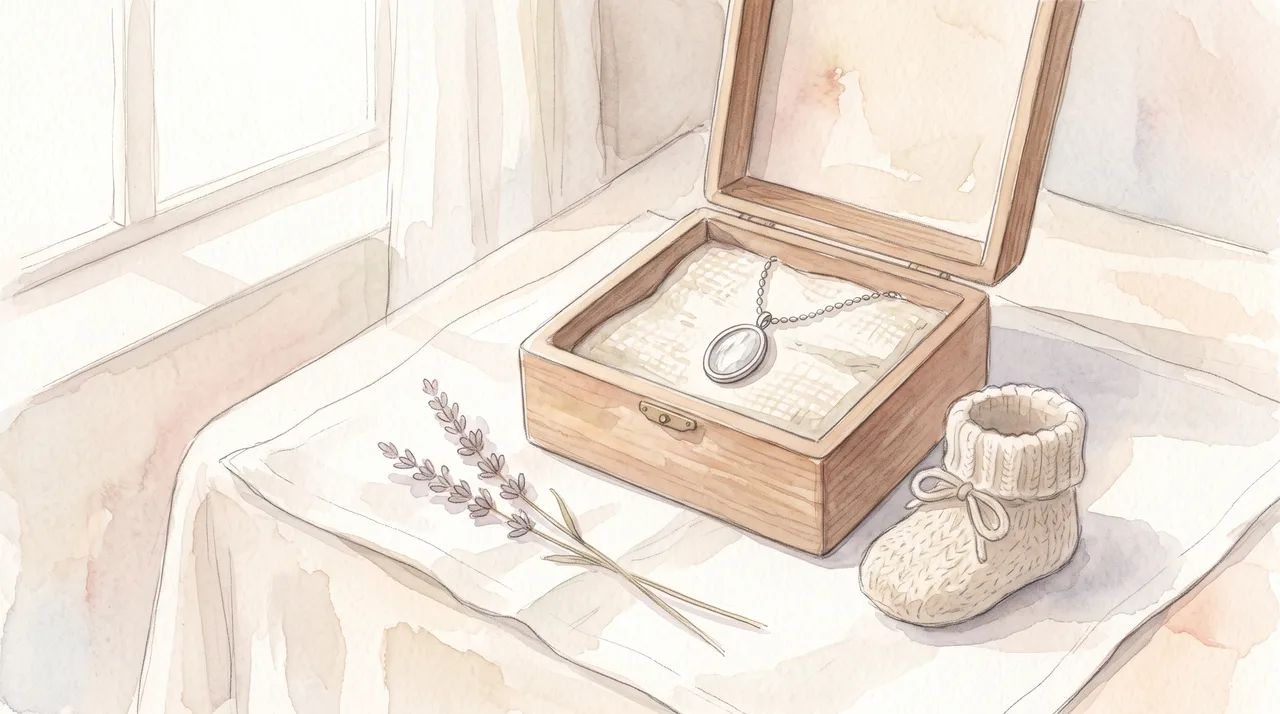
Have the first name in full engraved (not a nickname or a shortened form) and the date with the full year, written so that the day and month can't be mixed up. Everything else — a message, a title, the giver's name — belongs on the back, or nowhere at all: "our little princess" will date far sooner than the silver it's engraved in.
But baby jewellery is a keepsake for the box, not for the neck. A chain on a small child can catch on the cot, and broken jewellery means a small part in the airway; both are documented cases, not a theoretical risk.
What to engrave: the name, the date and nothing more
The engraving area is small, and every character you add shrinks all the others. So it pays to decide up front what has to last twenty years and what's just today's mood.
What stands the test of time: the first name in full and the date. "Tessie" is the name you use now — "Tessa" is the name she'll have at eighteen on her degree and her employment contract. A nickname on jewellery isn't a mistake; just bear in mind it becomes a memory of the parents rather than a mark of the owner.
What not to put on the front: the surname. A first name stays with a person, but a surname can change through marriage or the child's own decision, and a re-engraved surname shows on the piece forever. Likewise, leave out family labels ("from Nana") and any wording that describes the child as little — in twenty years an adult will be wearing it.
Use the back for things that genuinely don't change: a second date (the day the baby came home), the parents' initials or a single short word. If you're not sure, leave the back blank. Engraving can be added later; it can't be removed without a trace.
A date format nobody will puzzle over in twenty years
The date is the one part of an engraving that can be written correctly and still be unclear. The difference between formats only shows when the piece is held by someone who wasn't there.
| Format | How it reads | When to choose it |
|---|---|---|
| 5 March 2026 | day, month in words, year — the usual New Zealand style | The piece stays at home and there's enough room on the tag |
| 2026-03-05 | year, month, day (international order) | Can't be misread anywhere in the world; good for the back and for family records |
| 5 MAR 2026 | abbreviated month in letters | You want to rule out any mix-up but space is tight |
| 3/5/2026 | 3 May in New Zealand and Europe, 5 March in the US | Never — one format, two different dates |
| 5 March ’26 | shortened year | Never — in a hundred years nobody will know which century |
Engraving ideas to copy, by occasion
An engraver counts characters including spaces, full stops and separators — "5 March 2026" is two characters longer than "5March2026", and on a narrow pendant that matters. Before you order, write the wording on paper exactly as it should be engraved, spaces and all. You can copy the lines below and swap in the name and date.
Why a one-year-old shouldn't wear jewellery
In 2018 the US Food and Drug Administration (FDA) issued a warning about jewellery put on young children and described two specific reported cases: a seven-month-old choked on a bead from a wooden bracelet, while being supervised by a parent, and was taken to hospital; an eighteen-month-old was strangled during sleep by an amber necklace. The warning was aimed at jewellery sold to ease teething pain, but the mechanism is exactly the same for a decorative name chain: strangulation when the cord tightens or catches on the cot bars, and inhalation when the piece breaks and a small part comes loose.
The same test applies as with toys — anything that fits in the mouth and can come apart is a hazard for children under three; how to run through it is covered in our article on gift safety for the littlest ones. Jewellery almost never passes that test: it has a clasp, it has a small pendant, and by its very nature it goes round the neck.
None of this means jewellery with a name and date is a bad gift. It means being clear about who it's given to: it's bought for the child, but for the first few years a parent looks after it. Saying that out loud when you hand it over spares the family any awkwardness — and probably saves the piece, too, because it ends up in a box instead of in the cot.
Materials that last twenty years against the skin
An engraving only lasts as long as the metal it's cut into. These are the properties that decide that — and what to check before you buy.
- Nickel and allergiesThe European Union's REACH rules (Annex XVII, entry 27) limit nickel release from jewellery: no more than 0.2 µg/cm² per week for parts inserted into pierced ears and 0.5 µg/cm² per week for items in prolonged contact with the skin. They don't bind New Zealand retailers, but the key line of that entry is telling: a plated finish only has to keep within the limit for at least two years of normal wear. Two years, not twenty — which is why gold-plated costume jewellery isn't suited to a lifelong keepsake.
- Silver and its finenessSilver comes in several standard finenesses; most common is 925 (sterling silver), with 835 and 800 below it. Silver tarnishes over time as it reacts with sulphur compounds in the air; for a piece kept in a box, that means an occasional polish, not damage.
- GoldFor gold, 585 (14 carat) and 750 (18 carat) are common. A higher number means more gold and a softer metal: the engraving looks finer, but on a bracelet worn every day it wears smooth sooner. For a piece meant to be worn, 585 is usually more practical.
- The receipt to ask forAsk the seller for a receipt that states the type of metal, the price, the weight and the fineness. Keep that piece of paper with the jewellery — in twenty years, when someone asks what it's made of, it's the only proof.
- Engraving depthA shallow laser engraving gradually wears away on a bracelet worn every day; a deeper engraving lasts longer. Ask the engraver how deep they can go on that particular piece — on thin tags the depth is limited so the metal doesn't bend.
How to store it so it can still be found in twenty years
The most common fate of jewellery with a name and date isn't being lost but being forgotten: it sits in a drawer and nobody remembers who it was from or why.
- 1Photograph it straight awayIdeally close up, so the engraving is legible. A photo keeps the wording even if the inscription wears smooth over time.
- 2Add a note with the contextWho gave it, when and for what occasion. One handwritten sentence. You can't look this up anywhere else, and it's exactly what you'll tell the child when you hand it over.
- 3Keep it out of the bathroomHumidity and fumes from toiletries speed up silver tarnishing. A resealable pouch or a box with a seal works better than an open dish on a shelf.
- 4Put it with the other keepsakesOne place for everything — the jewellery, the handprint, the hospital bracelet. Scattered keepsakes get lost one at a time, never all at once.
- 5Tell someone else about itYour partner, the other grandparents, the child themselves as soon as they understand. A keepsake only one person knows about stops existing along with that person's memory.
When to give it to the child, and what to write down until then
The right moment to hand it over isn't set by age but by whether the child can attach a story to the piece and hold on to it. That's usually school age for a bracelet or pendant, later for a chain — and as a coming-of-age gift, jewellery with a birth date works best of all, because that's when the date carries weight.
Until then, the name and date don't have to wait in a box. The classic place to write both down is a book dedication: it holds a whole sentence instead of two lines and can be read long before the child understands what silver is. Other keepsakes given around the first year play the same role — there's an overview in our article on first birthday gifts.
And if the name should be right inside the story, a personalised book does the job: the hero is created from a single uploaded photo, the dedication is set on the first page, the book has 12 illustrated spreads and is usually ready within 15 minutes. Unlike jewellery, the child can have it close straight away.
Sources
- FDA: warning about jewellery worn by young children (2018) — Reported deaths and injuries — strangulation by a necklace during sleep, a bead from a bracelet choked on.
- REACH Regulation, Annex XVII, entry 27 (nickel) — EU limits on nickel release from jewellery and the requirement that a plated finish keep within them for at least two years of normal use.